Key Takeaways:
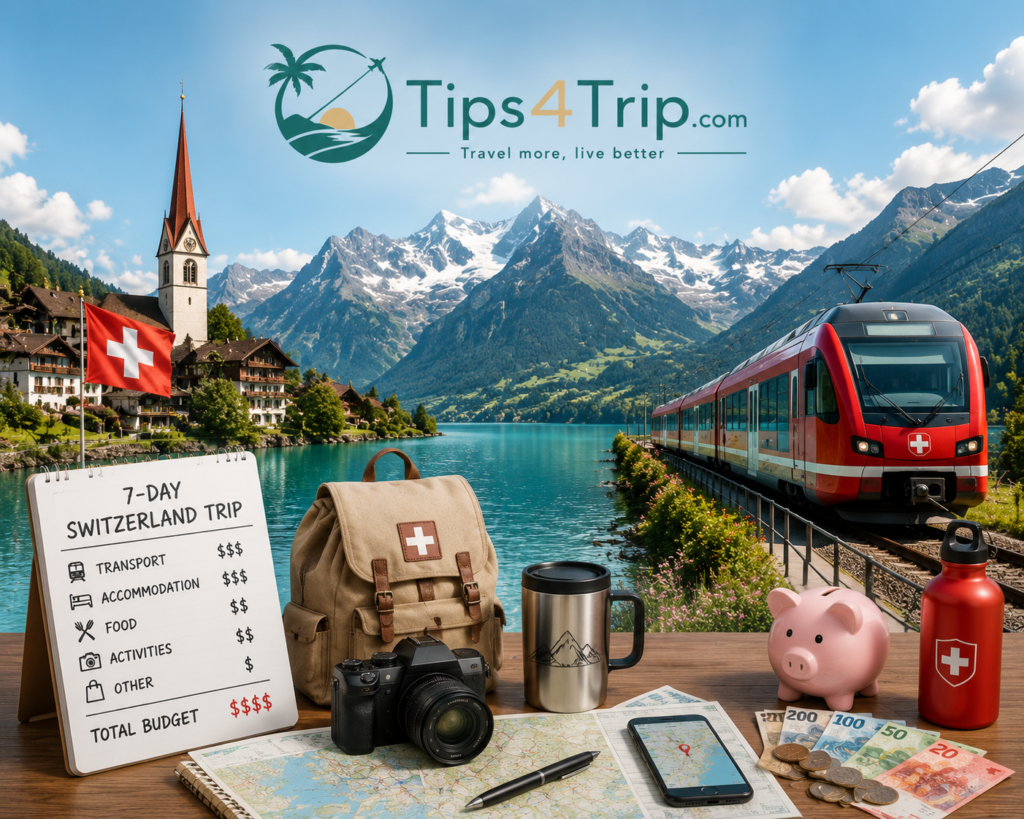
In 2026, a switzerland 7 day trip cost ranges from CHF 1,250 ($1,400) for budget travelers to CHF 2,800 ($3,150) for mid-range comfort.
- Budget tier total: Expect CHF 1,250 per person using hostel dorms (CHF 45–60/night), Coop grocery meals (CHF 20/day), and a Half Fare Card.
- Mid-range tier total: Plan for CHF 2,800 per person with 3-star hotels (CHF 180–250/night), mixed dining (CHF 65/day), and an 8-day Swiss Travel Pass.
- Hidden transit fee: The Swiss Half Fare Card costs CHF 150 in 2026; pass holders still face 25–50% surcharges on major cable cars like Jungfraujoch.
- Mandatory taxes: Tourist visitor fees (Kurtaxe) add CHF 2.50 to CHF 7.00 per person nightly, billed separately at check-out.
How Much Does a 7-Day Switzerland Trip Cost in 2026?
A standard 7-day vacation to Switzerland in 2026 requires an average budget of CHF 1,250 ($1,400) for budget travelers, CHF 2,800 ($3,150) for mid-range couples, and CHF 5,200+ ($5,800+) for luxury travelers per person. Prices reflect updated 2026 Swiss Federal Railways (SBB) transit tariffs, inflation-adjusted restaurant prices, and regional visitor tax updates across hubs like Zurich, Lucerne, Interlaken, and Zermatt.
Calculating your switzerland 7 day trip cost 2026 requires looking beyond rail passes and hotel room rates. Hidden fees such as peak-season mountain railway surcharges, compulsory municipal visitor taxes, and high dining service costs frequently surprise first-time visitors. The baseline breakdown below outlines where your money goes during a week in the Swiss Alps.
| Expense Category | Budget Tier (Per Person) | Mid-Range Tier (Per Person) | High-End Tier (Per Person) |
|---|---|---|---|
| Rail Pass & Transit | CHF 230 ($258) | CHF 439 ($492) | CHF 697 ($780) |
| Mountain Cable Cars | CHF 110 ($123) | CHF 210 ($235) | CHF 450 ($504) |
| Lodging (7 Nights) | CHF 385 ($431) | CHF 840 ($941) | CHF 1,920 ($2,150) |
| Mandatory Visitor Taxes | CHF 25 ($28) | CHF 35 ($39) | CHF 49 ($55) |
| Food & Dining | CHF 154 ($172) | CHF 455 ($510) | CHF 910 ($1,020) |
| Activities & Sightseeing | CHF 50 ($56) | CHF 150 ($168) | CHF 350 ($392) |
| Total 7-Day Cost | CHF 1,254 ($1,404) | CHF 2,729 ($3,056) | CHF 5,286 ($5,920) |
Transit Fee Audit: Swiss Travel Pass vs. Half Fare Card in 2026
The Swiss Half Fare Card (CHF 150 in 2026) is the most cost-effective transit pass for most 7-day itineraries, consistently beating the 8-Day Consecutive Swiss Travel Pass (CHF 439) whenever high-altitude mountain cable cars are included. Choosing the wrong transport pass is the single easiest way to overspend on public transport in Switzerland.
Swiss Federal Railways adjusted non-resident ticket pricing in 2026. Understanding the break-even math between the two primary transit passes prevents overpaying at the ticket counter.
The 2026 Rail Pass Break-Even Math
An 8-Day 2nd Class Swiss Travel Pass costs CHF 439. It offers 100% free travel on standard mainline SBB trains, post buses, and city public transit, along with free entry to over 500 museums. However, its coverage drops significantly on private mountain railways. For example, a pass holder only receives a 25% discount on the flagship Jungfraujoch summit train from Grindelwald or Wengen.
By contrast, the Swiss Half Fare Card costs CHF 150 for a 1-month validity window. It cuts ALL train fares, post buses, city public transit, AND high-altitude cable cars by exactly 50%. On major summit journeys, that extra discount creates massive savings.
| Route / Excursion | Full Fare Ticket | With Swiss Travel Pass | With Swiss Half Fare Card |
|---|---|---|---|
| Zurich Airport to Lucerne (Train) | CHF 27.00 | CHF 0.00 (100% off) | CHF 13.50 (50% off) |
| Lucerne to Interlaken Ost (GoldenPass) | CHF 34.00 | CHF 0.00 (100% off) | CHF 17.00 (50% off) |
| Jungfraujoch Return (Peak Summer) | CHF 234.80 | CHF 176.10 (25% off) | CHF 117.40 (50% off) |
| Schilthorn Cable Car Return | CHF 108.00 | CHF 54.00 (50% off) | CHF 54.00 (50% off) |
| Interlaken to Zermatt (Train) | CHF 86.00 | CHF 0.00 (100% off) | CHF 43.00 (50% off) |
| Sample Itinerary Total | CHF 489.80 | CHF 230.10 + Pass = CHF 669.10 | CHF 244.90 + Pass = CHF 394.90 |
Peak Cable Car Surcharges & Seat Fees
Mountain cable cars and scenic train lines carry additional mandatory fees that are rarely publicised. Between May 1 and October 31, 2026, SBB imposes a mandatory seat reservation fee of CHF 10 per person for return journeys to Jungfraujoch. Panoramic express lines such as the Glacier Express charge a mandatory seat reservation surcharge ranging from CHF 39 to CHF 49 per seat during peak season, regardless of whether you hold a valid pass.
Accommodation Rates & Mandatory Visitor Tax Audit (Kurtaxe)
Lodging in Switzerland for 2026 averages CHF 55 per night for hostel dorm beds, CHF 210 per night for a standard 3-star hotel room, and CHF 450+ per night for 4-star boutique chalets, plus a non-negotiable municipal visitor tax ranging from CHF 2.50 to CHF 7.00 per person per night.
When budgeting your switzerland 7 day trip cost 2026, note that third-party booking platforms rarely include local visitor taxes in the initial checkout total. You must pay this fee directly to the property upon check-out.
Regional Tourist Visitor Tax (Kurtaxe) Breakdown
Municipalities levy a daily tax per person to maintain regional hiking trails, public parks, and tourism infrastructure. In return, hosts issue a regional Guest Card providing free local bus transportation within town limits.
- Canton Lucerne: Increased its visitor tax to CHF 4.00 per person/night in 2026 to manage high tourism volume.
- Zermatt & Lauterbrunnen: Charge CHF 4.00 per person/night year-round.
- Montreux & Vaud Riviera: Charge up to CHF 7.00 per person/night for high-category accommodations.
- Zurich & Geneva: Charge urban accommodation taxes ranging between CHF 2.50 and CHF 3.50 per person/night.
Daily Food Cost Formulas: Supermarket Self-Catering vs. Sit-Down Dining
Daily food costs in Switzerland range from CHF 20 per person using supermarket grab-and-go self-catering to CHF 130+ per person when relying on traditional sit-down restaurants for daily meals.
Food selection represents the single largest variable when managing a switzerland 7 day trip cost 2026. Managing meal costs requires understanding the distinct price tiers available across Swiss towns.
Option A: Supermarket Self-Catering (CHF 18–25 / Day)
The main Swiss supermarket chains—Coop and Migros—offer extensive, high-quality grab-and-go sections. A daily food budget with self-catering breaks down as follows:
- Breakfast (CHF 4–5): Fresh croissant or bircher muesli (CHF 2.50) + bottled coffee (CHF 2.00).
- Lunch (CHF 7–9): Prepared pre-packed salad or deli sandwich (CHF 5.50–7.50) + sparkling water (CHF 1.20).
- Dinner (CHF 8–11): Microwaveable Swiss dish (e.g., pre-made spaetzle or fondue box CHF 6.50) + fresh fruit (CHF 2.50).
Option B: Department Store Cafeterias (CHF 45–65 / Day)
For cooked hot meals without restaurant prices, head to Coop Restaurant, Migros Restaurant, or Manor Manora restaurant buffets. These self-service spots serve traditional hot meals (Tagesgericht or daily plate) such as roast chicken with rösti or fresh pasta for CHF 14.50 to CHF 18.50 per plate.
Option C: Traditional Sit-Down Dining (CHF 90–140 / Day)
Standard sit-down restaurants in tourist hubs like Grindelwald or Zermatt carry substantial menu prices:
- Lunch Main Course: CHF 24–34 (e.g., personal pizza or sausage with rösti).
- Dinner Main Course: CHF 32–48 (e.g., traditional cheese fondue CHF 33, beef loin CHF 45).
- Beverages: CHF 5–7 for a soft drink or tap water service charge; CHF 8–12 for a glass of local Valais wine.
- Service Fee: Tipping is included by Swiss law, though rounding up by CHF 2–5 for good service is standard.
Itemized 7-Day Swiss Travel Budget Table for 2026
Executing a 7-day Swiss itinerary without budget overruns requires allocating funds across all core expense categories prior to departure. The table below outlines complete spending profiles for 7 days in Switzerland during 2026, assuming two travelers sharing hotel costs where applicable.
| Category Detail | Budget (Hostels & Grocery) | Mid-Range (3-Star & Mixed Meals) | High-End (4-Star & Dining) |
|---|---|---|---|
| Transit Pass | CHF 150 (Half Fare Card) | CHF 439 (8-Day STP 2nd) | CHF 697 (8-Day STP 1st) |
| Point-to-Point Train Tickets | CHF 80 (Half-price fares) | CHF 0 (Included) | CHF 0 (Included) |
| Mountain Excursions | CHF 110 (1 major peak) | CHF 210 (2 major peaks) | CHF 450 (3+ VIP peaks) |
| Lodging (7 Nights / Person) | CHF 385 (Dorm @ CHF 55) | CHF 840 (Hotel @ CHF 240/rm) | CHF 1,920 (Hotel @ CHF 550/rm) |
| Kurtaxe Visitor Taxes | CHF 25 (CHF 3.50/night) | CHF 35 (CHF 5.00/night) | CHF 49 (CHF 7.00/night) |
| Food & Dining (7 Days) | CHF 154 (Coop self-catering) | CHF 455 (Coop + 1 sit-down/day) | CHF 910 (Full restaurant service) |
| Museums & Activities | CHF 50 (Selective entries) | CHF 150 (Included / discounted) | CHF 350 (Private guided tours) |
| Total Cost Per Person (CHF) | CHF 954 – CHF 1,254 | CHF 2,500 – CHF 2,800 | CHF 4,800 – CHF 5,300 |
| Total Cost Per Person (USD) | $1,070 – $1,404 | $2,800 – $3,140 | $5,380 – $5,940 |
Frequently Asked Questions
Is the Swiss Travel Pass worth buying for a 7-day trip?
For a 7-day trip in 2026, the 8-day Swiss Travel Pass (CHF 439) is rarely the cheapest option if you visit high mountain peaks. The Swiss Half Fare Card (CHF 150) offers better value because it gives 50% off expensive cable cars like Jungfraujoch, whereas the Swiss Travel Pass only discounts them by 25%.
How much money do I need per day in Switzerland?
In 2026, a daily budget in Switzerland requires CHF 180 ($200) per person for budget travel, CHF 400 ($450) per person for mid-range travel, and CHF 750+ ($840+) per person for luxury travel. These figures include accommodation, public transport, daily meals, mountain cable cars, and local tourist taxes.
Are tourist visitor taxes included in hotel bookings in Switzerland?
No, Swiss visitor taxes (Kurtaxe) are rarely included in upfront online booking prices on sites like Booking.com or Airbnb. Expect to pay an additional fee of CHF 2.50 to CHF 7.00 per person per night directly at hotel check-out, depending on the canton and municipality you visit.