
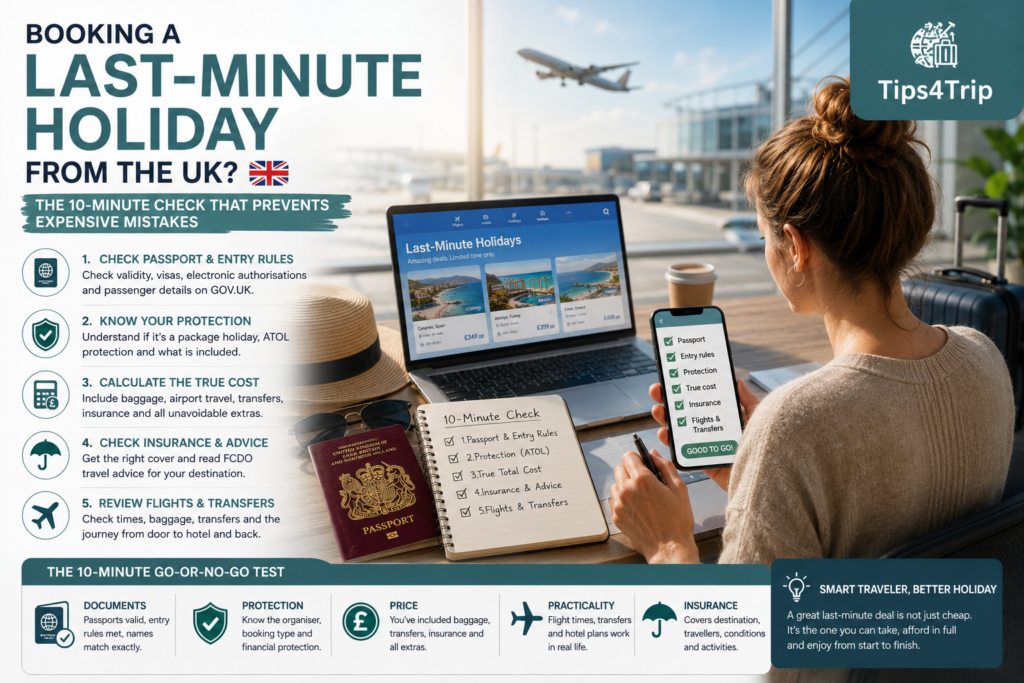
Booking a holiday close to departure can work well for a UK traveller, but only if speed does not replace basic checks. The attractive price is not the whole decision. Before paying, you need to know that your passport is accepted, the destination’s entry rules are manageable, the booking has the protection you expect, and the advertised price includes the essentials. A late deal is useful when you are flexible about the destination and dates; it is risky when you are still trying to solve a passport, insurance or airport problem.
The quickest safe approach is to separate the process into two stages. First, confirm that you can legally and practically take the trip. Then compare the offers on price, hotel, flights and included services. Ten focused minutes can prevent a much more expensive mistake than missing a discount.
1. Check that your passport can actually be used
Do this before becoming attached to a hotel. A British passport can look valid and still fail a destination’s entry requirements. Many European trips require travellers from the UK to check both when the passport was issued and how long it remains valid after the planned return. Other countries apply different rules, and some also require a visa, electronic authorisation or proof of onward travel.
Use the destination-specific entry requirements on GOV.UK rather than relying on a general rule remembered from a previous holiday. Check the passport for damage, too. A torn cover, loose pages or severe water damage can cause problems even when the dates printed in the document appear acceptable.
- Check the issue date and expiry date for every traveller.
- Confirm whether a visa, electronic authorisation or additional form is required.
- Make sure every name matches the booking exactly, including middle names where required.
- Check the documents of children and anyone travelling on a different nationality’s passport.
If one passenger needs a new passport or an approval that may not arrive before departure, do not treat the booking deadline as a reason to take the gamble. A cheap holiday that cannot be boarded is not a bargain.

2. Find out what kind of protection you are buying
At short notice, a package holiday is often worth considering because it can combine the flight and accommodation under one contract. Under the UK Package Travel and Linked Travel Arrangements Regulations, a trip that combines at least two relevant travel services for more than 24 hours or with an overnight stay may be a package. The legal classification depends on how the booking is sold, not simply on whether the website uses the word “package”.
A package holiday normally gives the traveller both financial and legal protection. For a flight-inclusive booking sold by a UK ATOL holder, the Civil Aviation Authority’s ATOL scheme is particularly important. After payment, the organiser should provide an ATOL Certificate showing who is protected and which company is responsible. Check the certificate and the operator’s details instead of assuming that every result on a search page has the same protection.
ATOL is not travel insurance. It is designed to protect certain flight-inclusive holidays if the relevant travel company fails, whereas insurance deals with medical treatment, cancellation, baggage and other risks according to the policy wording. If you book a flight and hotel in separate transactions with unrelated providers, you may not have the same package rights. When the booking process is unclear, ask the seller in writing what you are buying before making payment.
- Is this a package holiday, a linked travel arrangement or separate bookings?
- Who is the organiser and, where relevant, who is the ATOL holder?
- Will you receive an ATOL Certificate or another clear form of financial protection?
- Which parts are covered: flights, accommodation, transfers, car hire or excursions?
3. Compare the price you will really pay
A late holiday can look cheap because the first number leaves out the costs that become unavoidable once the departure is close. Compare the complete trip, not just the headline price per person. A useful working formula is:
True trip cost = booking price + baggage + travel to the airport + parking or rail fares + transfers + insurance + unavoidable extras.
Then check whether the offers are genuinely comparable. “Seven nights” does not tell you whether the outbound flight arrives in the morning or after midnight, whether the return flight removes most of the final day, or whether a long coach transfer makes the first evening impractical. The room type and board basis matter as well: breakfast, half board and All Inclusive are different products, even when the hotel name is identical.
- Departure airport: add fuel, parking, a train ticket or a hotel night if the airport is far from home.
- Baggage: confirm whether the fare includes only a small cabin bag or also checked luggage.
- Transfers: check whether a transfer is included, shared or private, and how long it normally takes.
- Room: look for economy, promotional, annex or limited-view room descriptions.
- Meals and drinks: read the board basis and any restrictions on restaurants, snacks or beverages.
- Payment: late bookings often require quick full payment, so leave room in the budget for insurance and airport costs.
Once these non-negotiables are clear, a live search of last minute offers can help you scan different dates, destinations, airports, lengths of stay and board options before you create a shortlist. Treat the displayed result as a changing snapshot: the final seller confirms the price, availability and booking conditions.
4. Check insurance and official travel advice before paying
Travel insurance should be part of the booking decision, not something added casually at the airport. Check medical cover, repatriation, cancellation, missed departure, baggage and personal liability. If you have a pre-existing medical or mental health condition, declare it accurately. A cheaper policy that excludes the reason you are most likely to claim is false economy.
A GHIC or EHIC can help with medically necessary state healthcare in eligible European countries, but it is not a replacement for travel insurance. It does not generally cover private treatment, repatriation or every additional cost created by an illness or accident. Read the policy excesses and exclusions, including rules about alcohol, sports, scooters and destinations where the Foreign, Commonwealth & Development Office advises against travel.
Before confirming the destination, read the current FCDO travel advice page. It brings together entry requirements, safety and security information, health warnings and local laws. This is especially important when you are booking a destination you chose only because it was available at a good price. If the advice changes, your insurance may also treat the situation differently depending on when you booked and what was already known.

5. Read the flight and transfer details as if you were already travelling
Last-minute listings encourage quick comparisons, but the practical details decide whether the holiday feels like a break. Write down the exact departure and return times, the airport and terminal, the baggage allowance, the transfer arrangement and the hotel check-in situation. Do not rely on a small “from” price or a short description when the full itinerary is available later in the booking process.
Think about the journey from your front door to the room, and then back again. A very early flight may require an airport hotel, a taxi or expensive parking. A late arrival may mean missing dinner or paying for food after landing. A resort far from the airport can turn a low price into a tiring first day, particularly on a short break. For a family, the extra travel time may be more important than a modest saving. For a couple travelling light, it may be an acceptable compromise.
Give special attention to the final day. A hotel booking may cover the night, while a pre-dawn transfer means you leave before breakfast. Ask what happens after check-out if the return flight is late, and whether luggage storage or continued use of facilities is included. These details are not always deal-breakers, but they should be part of the comparison.
The 10-minute go-or-no-go test
Use this short decision test immediately before payment:
- Documents: every passport, entry requirement and passenger name has been checked.
- Protection: you know the organiser, the booking type and the relevant certificate or financial protection.
- Price: baggage, airport travel, transfers, insurance and unavoidable extras are included in your calculation.
- Practicality: the flight times, transfer and hotel arrangements work from your home and back again.
- Insurance: the policy covers the actual destination, travellers, medical circumstances and activities planned.
If one answer is “I am not sure”, pause and ask the seller. Last-minute availability can disappear, but uncertainty does not become safer because a countdown clock is running.
When a late booking is the wrong choice
Flexibility is valuable, but it cannot solve every travel problem. Booking close to departure is a poor fit when you need a particular hotel, a specific room, a school-holiday date, a precise airport or a complex flight connection. It is also unsuitable when a passport renewal, visa decision or medical declaration is still unresolved. In those situations, paying earlier for certainty may cost less than trying to repair a failed booking.
For everyone else, the sensible strategy is simple: decide what must not change, stay flexible on everything else, and compare the whole journey rather than the first price you see. The best late deal is not necessarily the cheapest package on the screen. It is the one you can legally take, afford in full and enjoy from the moment you leave home until you return.