Key Takeaways:
A Santorini caldera cave suite is a subterranean structure excavated into volcanic cliffside rock, offering unique bioclimatic climate control and dramatic sea views.
- Architectural definition: Built horizontally into volcanic ash without conventional foundations, using vaulted masonry and thick stone walls.
- Floor-area bonus: The Greek New Building Code (NOK, Law 4067/2012) grants a 50% square-footage floor-area bonus for subterranean yposkafo builds.
- Permit suspension: Ministry of Environment regulations suspend all new permits and pool builds in the Caldera zone until December 31, 2026.
- Legal compliance: Existing hotels must complete structural stability studies within a two-year window and obtain archaeological clearance.
What is the definition of a caldera cave suite in Santorini?
A Santorini caldera cave suite (yposkafo) is a subterranean architectural structure excavated directly into volcanic ash and tuff cliffside rock, featuring a narrow facade, whitewashed masonry barrel vault, and deep underground living spaces. Rather than relying on traditional timber framing or concrete frames, these homes leverage the earth itself for insulation and enclosure.
Historically constructed by sailors and local villagers seeking refuge from winter winds and summer heat, these cave dwellings transformed over the past few decades into high-end boutique hospitality spaces. The unique geology of the Cycladic island allows artisans to carve rooms deep into the rock face. Today, these subterranean suites line the dramatic cliffs of Oia, Imerovigli, Fira, and Firostefani, offering sweeping views of the drowned volcanic caldera below.
How are traditional yposkafa cave suites built?
Traditional yposkafa dwellings are excavated horizontally without conventional foundations, using the surrounding volcanic rock as high thermal mass for natural bioclimatic temperature and humidity regulation. Because the volcanic tuff remains at a stable ambient temperature year-round, these subterranean rooms stay naturally cool during scorching Aegean summers and warm during windy Cycladic winters.
The construction technique follows a distinct structural logic. Local builders dig directly into the cliff face, shaping long, arched tunnels. To prevent structural failure, master masons reinforce the exposed ceilings with whitewashed masonry barrel vaults made from local stone and volcanic pozzolanic mortar. Because the structure is tucked away inside the cliff, the living quarters extend deep into the rock face with minimal exterior wall exposure.
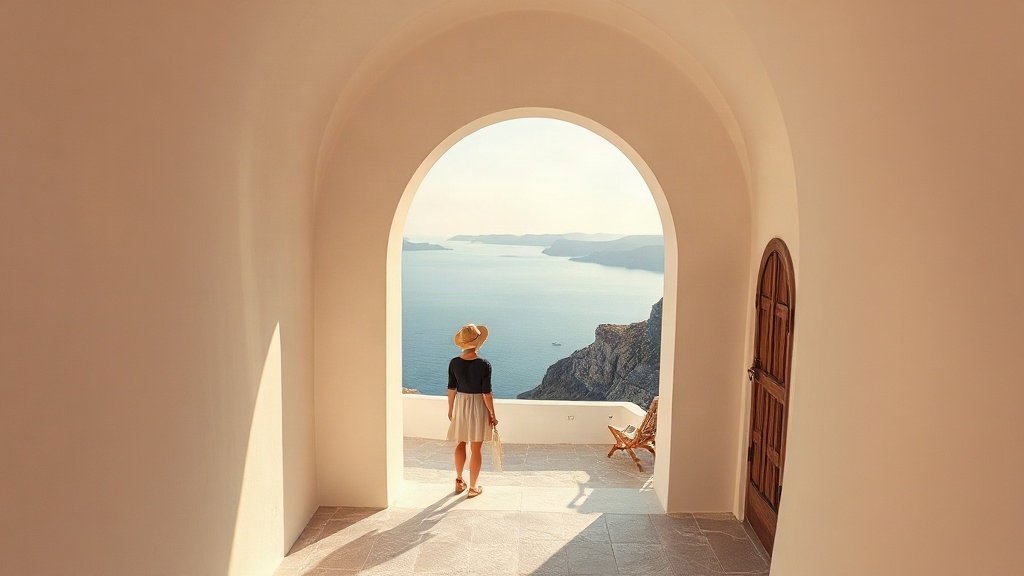
This layout creates a dramatic spatial experience. The main entrance and narrow facade house the primary light sources—typically a door flanked by two small arch windows—while the rear rooms (historically used for food storage or sleeping quarters) reside entirely underground. Modern conversions reconfigure these deep inner chambers into luxury bathrooms, indoor soaking tubs, and intimate sleeping nooks.
What are the regulatory rules for building cave suites in Santorini?
Developing or restoring a subterranean cave suite in Santorini involves navigating strict national architectural laws and municipal zoning regulations designed to preserve the island’s vulnerable geological profile.
Under the Greek New Building Code (NOK, Law 4067/2012), developers receive a notable spatial incentive: the code grants a 50% square-footage floor-area bonus for subterranean yposkafo constructions compared to standard above-ground plots. This allowance was intended to encourage low-profile, landscape-integrated development rather than bulky above-ground hotel blocks.
However, recent environmental and structural assessments have tightened development rules across the island. Under Presidential Decree and Ministry of Environment regulations, building permits for new constructions, expansions, and swimming pools in the Caldera zone of Thera and Thirassia are suspended until December 31, 2026. This temporary moratorium aims to protect the fragile cliffside from over-excavation, water leaks, and excessive structural loading.
Furthermore, local authorities are enforcing rigorous safety audits on commercial cave properties. All existing caldera-zone tourism businesses including cave suite hotels are required to complete and submit structural capacity and stability studies within a 2-year window as mandated by the Ministry of Environment and Energy. Additionally, because the island holds rich historical layers, any excavation or alteration of yposkafo cave structures requires mandatory archaeological clearance from the Ephorate of Antiquities of the Cyclades.
At a glance: Santorini cave suite rules and architectural traits
| Regulatory & Architectural Aspect | Legal Framework / Requirement | Impact on Cave Suite Design |
|---|---|---|
| Structural Construction | Subterranean excavation into volcanic ash/tuff | Requires barrel vaults; natural thermal mass insulation |
| Density Bonus | Greek New Building Code (NOK, Law 4067/2012) | Grants 50% floor-area bonus for underground builds |
| Development Moratorium | Ministry of Environment Decree (YPEN) | New permits and pool construction suspended through Dec 31, 2026 |
| Safety Compliance | Ministry of Environment Audit mandate | Mandatory structural stability study submitted within 2-year window |
| Heritage Protection | Ephorate of Antiquities of the Cyclades | Mandatory archaeological approval before any cliff excavation |
What are the honest pros and cons of staying in a cave suite?
Staying in an authentic yposkafo offers an unmatched sense of place, but the underground architecture presents practical trade-offs that every traveller should understand before booking.
The advantages
The primary draw of a caldera cave suite is its remarkable natural climate control. Thanks to the massive thermal inertia of the volcanic rock, the internal temperature remains surprisingly mild, reducing the need for heavy air conditioning. Acoustically, deep cave rooms offer extraordinary sound insulation; once you step inside and close the door, the noise from foot traffic on the caldera pathways completely disappears.
Visually, the minimalist interior aesthetics—smooth whitewashed plaster, rounded organic corners, and soft vaulted lines—create a serene environment that contrasts dramatically with the bright Aegean sunlight outside.
The drawbacks
The deepest spatial drawback of a true cave suite is natural lighting and air ventilation. Because only the front facade exposes windows to the outdoors, deep interior rooms rely on artificial lighting and mechanical ventilation systems to control ambient humidity. Travellers prone to claustrophobia may find the deep, windowless back chambers somewhat confining.
Additionally, because these suites follow the natural contour of the volcanic cliff, accessing them involves negotiating steep, uneven stone stairs. Carrying luggage up and down the caldera wall can be physically demanding, and mobility-impaired guests may find access difficult.
How do cave suites compare to standard above-ground hotels?
Choosing between a cave suite and a conventional hotel room on Santorini comes down to personal preference regarding light, layout, and atmosphere.
Standard above-ground hotel rooms offer floor-to-ceiling balcony glass, multi-directional cross-breezes, and traditional square-room layouts. However, they absorb the intense summer heat directly through roofs and exterior walls, relying heavily on air conditioning units. They are also fully exposed to wind gusts during Aegean storms.
Cave suites trade bright multi-sided windows for acoustic silence, dramatic structural character, and natural thermal comfort. While you step outside onto your private terrace for sunshine and caldera views, returning inside offers a cool, cocoon-like retreat built directly into the geological history of Santorini.
Frequently Asked Questions
Why are cave suites called yposkafa in Greece?
The term yposkafo comes from the Greek words meaning “dug under.” It accurately describes traditional subterranean structures excavated horizontally into volcanic cliff slopes without standard external walls or built foundations.
Are cave suites safe during earthquakes in Santorini?
Traditional vaulting techniques and natural volcanic rock mass provide strong structural flexibility. Furthermore, Greek regulations require existing caldera cave hotels to submit comprehensive structural capacity and stability studies to guarantee guest safety.
Can developers build new cave suite pools in Santorini right now?
No. Under current Ministry of Environment regulations, all new building permits, structural expansions, and swimming pool constructions along the Thera and Thirassia Caldera zone are strictly suspended until December 31, 2026.