Key Takeaways:
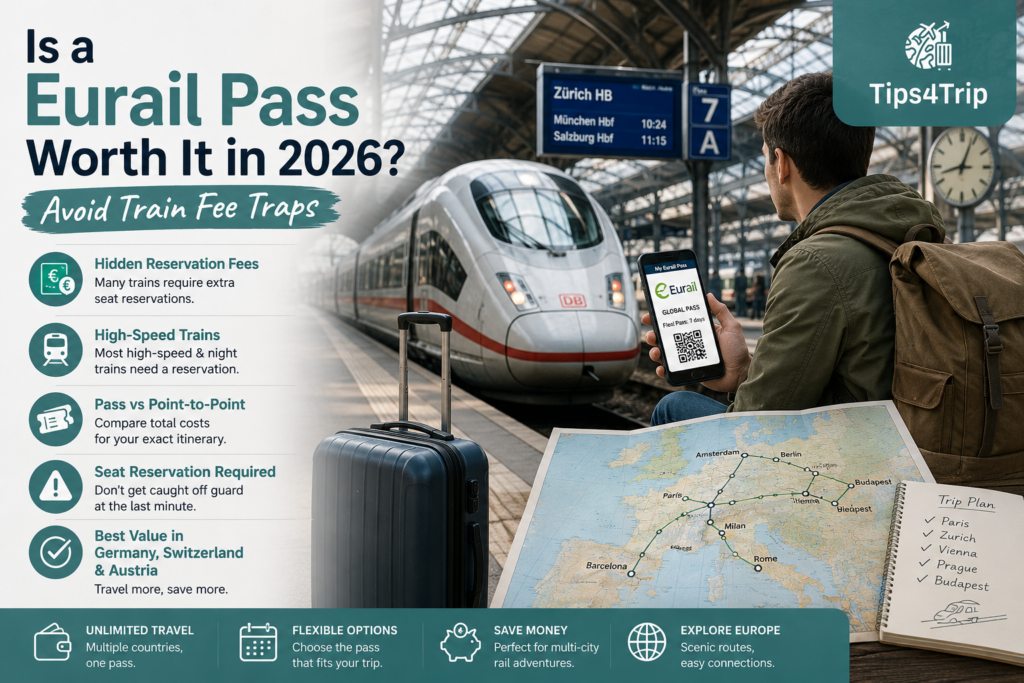
When analyzing a Eurail pass vs point to point tickets 2026, passes lose money on high-speed Western European routes due to mandatory seat reservation fees.
- High-Speed Surcharges: Passholders pay €10 to €45 in mandatory reservation fees per leg on Eurostar, TGV, Frecciarossa, and AVE trains.
- Break-Even Point: A 4-day Global Flexi Pass costs €286, but total expense climbs to €375 after adding mandatory reservation supplements.
- Advance Discount Winner: Booking point-to-point tickets 60–90 days ahead for high-speed routes costs as little as €137 total for four major Western European legs.
- Where Passes Excel: Eurail provides maximum value in Germany, Switzerland, and Austria, where high-speed trains require zero seat reservation fees.
The Mandatory Reservation Trap: Why High-Speed Europe Breaks Rail Pass Math in 2026
A Eurail Pass does not give you unlimited free train rides in Western Europe because major national rail carriers charge compulsory seat reservation fees ranging from €10 to €45 per individual leg. When evaluating a Eurail pass vs point to point tickets 2026 for Western Europe, travelers often miss these hidden reservation surcharges.
High-speed networks across France (TGV), Italy (Frecciarossa), Spain (AVE), and international lines (Eurostar, TGV Lyria) operate on mandatory reservation systems. You cannot board these trains with a rail pass alone; you must purchase a passholder seat reservation in advance. On many routes, passholder seats are strictly capped by a ticket quota. Once that quota fills up, passholders are locked out of the train, even if standard seats remain open for individual retail buyers.
For 2026 travel, these seat supplements add substantial extra expense to your journey. Eurostar charges passholders €35 between London and Paris or Brussels. Domestic French TGVs charge €10 for early passholder seats and €20 once the initial quota fills. TGV Lyria cross-border routes into Switzerland demand €29 to €39, while international TGV routes between Paris and Barcelona cost €35 per seat.
2026 Price Comparison: Eurail Pass vs Point-to-Point Tickets
Comparing a Eurail pass vs point to point tickets 2026 reveals stark cost differences across major transit corridors. Buying early-bird individual tickets is significantly cheaper than pass travel on high-speed networks, whereas rail passes offer better flexibility in Central Europe.
| Criterion | Eurail Global Pass (4-Day Flexi) | Point-to-Point Tickets (Advance Fares) | Best Choice |
|---|---|---|---|
| Average Total Cost (4 High-Speed Western Legs) | €375 (€286 pass + €89 seat fees) | €137–€180 (Booked 60 days out) | Point-to-Point (Saves €195–€238) |
| Seat Reservation Friction | High (€10–€45 fees + quota limits) | Zero (Seat automatically assigned) | Point-to-Point |
| Spontaneity in Central Europe (DE/AT/CH) | High (Hop on ICE/SBB without reservations) | Low (Requires fixed departure times) | Eurail Pass |
| Booking Window Advantage | Flexible activation within 11 months | Best prices 60–120 days out | Depends on trip timing |
Itemized Route Breakdown: Advance Fares vs Passholder Supplements in 2026
Calculating the exact costs for a standard 4-leg Western Europe route shows that individual early-bird tickets beat a 4-day Eurail Global Pass by over €200. Here is how the math breaks down for an adult traveler taking four major high-speed journeys.
- Leg 1: London to Paris (Eurostar)
Advance Ticket: €44 (Booked 90 days out).
Eurail Cost: €71.50 (1 day of €286 pass) + €35 passholder fee = €106.50. - Leg 2: Paris to Milan (TGV InOui)
Advance Ticket: €49 (Prem’s fare).
Eurail Cost: €71.50 + €31 passholder fee = €102.50. - Leg 3: Milan to Rome (Frecciarossa)
Advance Ticket: €24.90 (Super Economy fare).
Eurail Cost: €71.50 + €13 passholder fee = €84.50. - Leg 4: Madrid to Barcelona (AVE)
Advance Ticket: €19.00 (Promo fare).
Eurail Cost: €71.50 + €10 passholder fee = €81.50.
The total price for all four point-to-point advance tickets comes to €136.90. In contrast, the Eurail option totals €375.00 (€286 pass + €89 reservation fees). Buying individual tickets saves €238.10 while securing guaranteed seat assignments without fighting passholder quota limits.
Where Does a Rail Pass Still Make Financial Sense in 2026?
A Eurail Pass delivers maximum financial value in Central Europe, Great Britain, and Switzerland, where high-speed trains do not impose compulsory seat reservation fees. In these regions, a rail pass functions as true hop-on, hop-off transit.
Germany’s Deutsche Bahn (DB) network allows passholders to board high-speed Intercity Express (ICE) trains without reservations, though optional seat reservations cost €5.50. Switzerland’s federal railway (SBB) requires no reservations on standard routes like Zurich to Interlaken or Lucerne to Geneva. Austria’s ÖBB Railjet services operate under optional €3 seat reservations.
If your itinerary focuses on long, multi-hop routes across Germany, Austria, and Switzerland—or involves frequent regional day trips—a Eurail Pass provides both cost savings and total flexibility.
How to Decide Which Option Fits Your 2026 Travel Style
Deciding between a Eurail pass vs point to point tickets 2026 comes down to route geography and advance planning discipline. Follow these three steps to select the cheapest option for your journey.
- Map Your Carrier Types: List every train connection. If more than half your journeys involve Eurostar, French TGVs, Italian Frecciarossas, or Spanish AVEs, skip the pass.
- Check Release Windows: Advance tickets open 90 to 120 days before departure on SNCF, Trenitalia, Renfe, and DB websites. If you are inside this window, individual tickets will almost always win on price.
- Tally Total Surcharges: If you buy a pass, add up every mandatory passholder fee on your route before purchasing to calculate your true total out-of-pocket expense.
Frequently Asked Questions
Is a Eurail Pass cheaper than buying point-to-point train tickets in 2026?
A Eurail Pass is usually more expensive than point-to-point tickets for Western European high-speed rail itineraries. Mandatory passholder seat reservation fees on Eurostar, TGV, Frecciarossa, and AVE add €10 to €45 per leg. Point-to-point tickets booked 60 to 90 days in advance offer significantly lower total travel costs.
Can Eurail passholder seat reservations sell out on high-speed trains?
Yes, Eurail passholder seat reservations frequently sell out weeks ahead of departure on popular high-speed lines. Train operators limit passholder seat quotas on Eurostar and French TGVs. Once the quota is full, you cannot board with a pass, even if standard full-fare point-to-point tickets remain available for purchase.
How far in advance should I buy point-to-point train tickets in Europe?
You should buy point-to-point train tickets 60 to 120 days in advance to lock in early-bird discounts. National rail operators like SNCF, Deutsche Bahn, Trenitalia, and Renfe release their cheapest tier tickets roughly three to four months prior to travel, offering savings up to 70% off walk-up prices.